Russia dances the Cossack to the rhythm of the csárdás. How loudly is the music heard from the Kremlin?

Viktor Orbán, Hungary, and the FSB’s Geopolitical Trap
In previous episodes, we explored the ideological architecture of Russian influence and the mechanisms through which the FSB operates in Europe, revealing a complex hybrid warfare strategy, with Aleksandr Dugin providing part of the score. Now, our gaze turns to the heart of Europe, where the pulse of this Kremlin music seems to beat most strongly, resonating with Hungarian rhythms.
Hungary, under the leadership of Viktor Orbán, is not merely a passive actor but an active vector of this influence, transforming the country’s internal and external policy into a platform for challenging European unity and transatlantic solidarity. Let us explore how Hungary, under Orbán, has been led to the brink of collapse, how the state has been captured, and how Hungarian national interests have been subordinated to an illiberal agenda, often convergent with that of the Kremlin, transforming Hungary into a pawn in a much larger geopolitical game.
The assertion that Viktor Orbán is no longer a viable solution for Hungary, leading the country to the brink of collapse and managing Hungarians’ resources as he wished without real state control, is not a mere hypothesis, but a conclusion reached by an increasing number of analysts and, to an increasing extent, even segments of Hungarian society. The state, in today’s Hungary, has become ”Viktor Orbán”, a reality that evokes a dictatorial model, not only through rhetoric but through concrete actions that undermine democracy. Through his FIDESZ party, Orbán has orchestrated a profound reform of the legal, electoral, and media systems, transforming Hungary from a liberal democracy into a de facto ”illiberal democracy”. Control over the media is almost total, with most major media institutions in the hands of oligarchs close to FIDESZ or directly under government control, drowning any critical voice in an ocean of propaganda. The constitution has been rewritten to consolidate executive power, and the independence of the judiciary has been eroded through political appointments and restrictions on judges’ autonomy. The electoral process, though formally respected, has been manipulated through changes in constituencies and FIDESZ’s disproportionate access to resources and media space. These actions are not simple deviations, but a methodical deconstruction of the pillars of the rule of law, designed to ensure Viktor Orbán virtually unlimited power and to nullify any checks and balances mechanism.
Such a concentration of power indeed recalls autocratic models, where ”the state is me” becomes a cruel reality, where the will of a single person is translated into law, and individual liberty is annihilated under the pretext of national cohesion.
Hungary’s economy, under Viktor Orbán’s government, has been managed in a way that has favored the interests of a narrow circle of those close to power, undermining fair competition and creating a widespread system of clientelism. National resources, from agricultural land to infrastructure, have often been directed to loyal oligarchs, to the detriment of sustainable economic development and the general welfare of the population. This management of resources, described as ”as he wanted”, without real state control, has led to a host of overvalued projects, opaque contracts, and growing inequality.
Despite some apparent economic growth, driven by certain foreign direct investments and European funds, the foundations of the Hungarian economy remain vulnerable. Energy dependence on Russia, for example, is not only a geopolitical problem but a major economic vulnerability, placing Hungary in a position of blackmail. Scenarios about a ”collapse” are not exaggerated, given the perceived level of corruption, the migration of independent capital, and the erosion of international investor confidence. Nationalist rhetoric and international isolation, while they may temporarily mobilize a portion of the electorate, carry a long-term economic cost, diminishing Hungary’s attractiveness as an investment destination and blocking access to essential European funds. This trajectory, documented by numerous reports from international organizations and the Western press, indicates a dangerous deviation from the path of prosperity, sacrificing the long-term future for the consolidation of short-term power.
Under the guise of patriotism and the defense of national sovereignty, Viktor Orbán has cultivated a profoundly nationalistic, often chauvinistic, rhetoric that has polarized Hungarian society and strained relations with its neighbors, which serves not only to consolidate the internal electoral base but also to distract attention from internal problems, blaming Brussels or external actors for any failures. The disconnection from European reality, by blocking decisions at the EU level and by challenging the fundamental values of the European Union, has transformed Hungary into a ”black sheep” of the community bloc, a position which, far from strengthening the country, isolates it and diminishes its real influence, turning it into a useful tool for the divisive strategies of external powers, such as Russia. This strategy is, in a profound sense, a betrayal of the European ideal that guided Hungary after the fall of communism, an act of self-isolation which, ultimately, weakens the country’s position on the international stage.
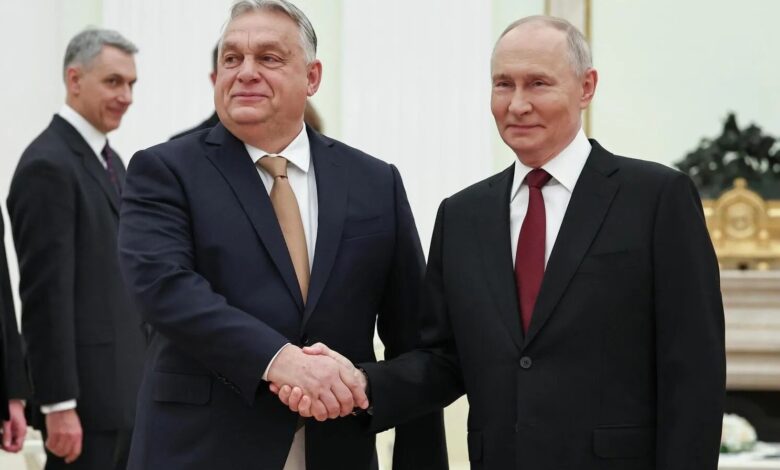
The ties between Viktor Orbán and Moscow are no secret, but an openly acknowledged reality, often justified by Budapest as ”pragmatic national interests”. However, a deeper analysis reveals a complex, pragmatic, yet also ideological symbiosis that transcends simple economic calculations, transforming Hungary into an essential pawn in the FSB-orchestrated strategy to destabilize Europe. The main pillar of this relationship is Hungary’s energy dependence on Russia. Projects such as the expansion of the Paks nuclear power plant (Paks II), largely financed by Russian loans and carried out by Rosatom (Russia’s state energy giant, responsible for the entire chain of the Russian nuclear industry, from research and development of nuclear technologies, design and construction of reactors, to the production of nuclear fuel, operation of nuclear power plants, management of radioactive waste, and export of nuclear services and equipment globally, while also being a strategic actor in energy geopolitics, influencing international energy markets, collaborating with numerous countries for the construction and modernization of reactors, and representing one of Russia’s most important tools in promoting energy security and technological influence worldwide), underscore not only an economic but also a strategic dependence, which gives Moscow considerable leverage over Hungarian policy. This dependence contradicts European efforts to diversify energy sources and reduce vulnerability to Russia, making Hungary a weak point in the European Union’s energy strategy. The European and American press have widely documented these connections, highlighting the risks of security and influence, often ignored or minimized by Hungarian officials.
Beyond economic aspects, there is a strong ideological alignment between the Orbán regime and the Kremlin. Both governments share a virulent criticism of Western liberalism, promoting nationalist, conservative values and a vision of a strong, authoritarian state. Viktor Orbán, through his concept of ”illiberal democracy”, legitimizes a political practice that approaches the Russian model, challenging European institutions and promoting a narrative of absolute national sovereignty. This ideological convergence makes Hungary a natural partner for Russia in the ”hybrid war” of values, a platform from which anti-EU, anti-NATO, and anti-liberal messages can be launched, contributing to the division and weakening of European cohesion. Viktor Orbán’s discourse, although formulated in language adapted to European sensibilities, reiterates fundamental themes of Russian propaganda: criticism of ”globalism”, defense of ”traditional values” against ”Western decadence”, and rejection of the ideas of the rule of law and human rights when these conflict with the interests of power.
The alarming cooperation between Hungarian intelligence services, the ”Hungarian Information Office”, and the FSB is flagrantly exemplified by the ”Minority Safepack” case. This initiative, presented as a European citizens’ initiative for the protection of Hungarian minorities, proved to be a ”maskirovka” (a complex Russian doctrine of military, political, and informational disinformation and dissimulation. It goes beyond physical camouflage, including denial of intentions, simulation of forces, and strategic manipulation, being actively applied both in wartime and peacetime to mislead adversaries), an influence operation conceived by Budapest and Moscow to create new diversions within the European Union. The documentation details how the campaign coordinator, Laszlo Petsy, made multiple visits to Moscow, where he was caught at the Marriott hotel alongside Irina Romanova, a communications specialist with direct ties to the FSO (Federal Protective Service), the secret agency responsible for the security of the Kremlin and Vladimir Putin, and to the state television channel Russia1. Romanova’s firm, expli.ru, was hired for ”advertising, consulting, and online media campaigns”, essential for promoting ”Minority Safepack” including in Romania. These direct connections with the Russian security and propaganda apparatus reveal the true nature of the initiative: an instrument of state influence, masked as a civic movement. The fact that this campaign was financed with ”hundreds of millions of forints from Hungarian government money”, paid to Laszlo Pesty’s firms (Írdalá.hu and Nonprofit Kft.), raises serious questions about the use of public funds from an EU and NATO member state to serve an agenda, at least partially, dictated by the Kremlin. These aspects have been intensely debated in the press in Hungary, Russia, Europe, and the USA, highlighting Hungary’s vulnerability to external influence and its role as a vector of this influence. Pesty László’s contacts with Szilárd Kiss, a former Hungarian diplomat in Moscow, and the signature collection activity among Russian-speaking minorities in the Baltic States demonstrate an extension of this strategy of instrumentalizing minorities, perfectly aligned with the Kremlin’s agenda.
Furthermore, ”Minority Safepack” conveyed all of Moscow’s theses regarding the protection of minorities and their right to self-determination, narratives identical to those used by Vladimir Putin to justify the invasion of Ukraine under the pretext of protecting the Russian minority. The warning from former Hungarian Foreign Minister Péter Balázs that ”if Laszlo Pesty goes to Moscow on the issue of the Székelys, he is knocking on the wrong door”, and that ”Vladimir Putin is not an angel of peace or an angel of minorities” underscores the dangerous nature of this cooperation. Even Frans Timmermans, Vice-President of the European Commission, directly signaled to Prime Minister Viktor Orbán ”the involvement of the Russian Federation” in the initiative, which contributed to its rejection by the European Commission. This was not a simple political divergence, but a recognition that, for a period, the United States and European allies bit the FSB bait and fell into the trap of Viktor Orbán and Vladimir Putin, underestimating the depth of this subversive alliance and its long-term consequences. Hungary’s foreign policy, visibly pro-Russia, manifested by its refusal to send weapons to Ukraine and maintaining ties with Vladimir Putin, creates profound tensions between Budapest and Bucharest, placing UDMR in an unenviable position, caught in the middle and often pressured to adopt Budapest’s line.
In this complicated geopolitical landscape, the Democratic Alliance of Hungarians in Romania (UDMR) is not a mere observer, but an actor with an active and deeply problematic role. Under the guise of representing the interests of the Hungarian minority in Transylvania, UDMR has functioned, in recent years, as a faithful extension of Budapest’s policies, transforming, in an almost cynical way, the community it claims to represent into a ”mass of maneuver” for external interests, often convergent with those of Moscow. This strategic alignment, although it may seem pragmatic in the short term for UDMR politicians, represents a fundamental betrayal of the Hungarian community in Transylvania and a serious danger for Romanian-Hungarian coexistence.
Viktor Orbán, with an ambiguous vision of a ”Greater Hungary” and an extended ethno-cultural sphere of influence, has not defined UDMR as a simple minority organization defending its rights in a neighboring state, but as a ”factor of national strategy for Hungary”. This declaration, far from being mere rhetoric, explicitly frames UDMR within a cross-border political project, subordinating the local interests of Hungarians in Romania to Budapest’s national strategy. UDMR leaders, including Kelemen Hunor, have consistently expressed their support for the continuation of FIDESZ’s government in Hungary, transforming UDMR into an extension of Viktor Orbán’s party in Transylvania. The electoral mobilization organized by UDMR, through the active collection of mail-in votes from Transylvania for elections in Hungary, aims to maximize votes for FIDESZ-KDNP, confirming this subordination.
The instrumentalization of ethnic Hungarians is a tactic that has also been observed in Moscow, where Russian minorities in neighboring states are often used to create levers of influence. Budapest’s policy of instrumentalizing its ethnic communities abroad has been seen by some analysts as similar to tactics used by Moscow to create influence in neighboring states, generating tensions and undermining sovereignty. Media networks dominated by pro-government Hungarian associations (supported by Budapest) in Transylvania often disseminate narratives that align with FIDESZ’s policies, exerting constant pressure on the Hungarian minority to adopt a certain political line, to the detriment of a pragmatic approach focused on the real interests of Romanian citizens of Hungarian ethnicity. This phenomenon is particularly pronounced in the so-called ”Székely Land”, where local leaders such as Csaba Borboly, president of the Harghita County Council, publicly declare that ”Harghita County must be there for all initiatives that serve the Hungarian cause”, supporting initiatives which, as demonstrated in the Minority Safepack case, are geopolitical instruments with Russian undertones.
UDMR’s position is profoundly problematic and, in an essential sense, a betrayal. It is a betrayal of the fundamental commitment to the citizens it represents, transforming them into mere tools for the political agenda of a foreign government, even if it is Hungary. Moreover, it is a betrayal of the principles of Romanian-Hungarian coexistence, a harmony built with difficulty over centuries, now undermined by chauvinistic elements and petty interests. UDMR, as a political party, is no longer a viable solution for representing Hungarians in Transylvania, but has become a structure where some ”politicians” get rich by exploiting ethnic and nostalgic sentiment. This party, a constant presence in Romanian governments for over 35 years, appears to have been supported, in a paradoxical and deeply destabilizing way, even by the Romanian Intelligence Service (SRI), fueling speculation that its political stability has served obscure interests, to the detriment of national cohesion and security.
Time has shown that this policy of small steps, promoted by Budapest and executed by UDMR, has begun to bear fruit for the revisionist agenda, as also seen through the support from some Romanian MEPs for the Russian-Hungarian ”Minority Safepack” initiative. The initiative, which aimed to decouple ethnic Hungarians from the rule of law, to be directly coordinated by the Budapest government, was an attempt to create, in the heart of Europe, ”separatist regions”. The ”Minority Safepack” campaign, which managed to collect 271,665 signatures in Romania, was a machination against the rule of law and proof of how ethnic identity was instrumentalized for geopolitical purposes.
During the ”Minority Safepack” campaign, which collected 271,665 signatures in Romania, the SRI had the capacity to monitor and, theoretically, to intervene to prevent the massive collection of signatures that could have influenced the European agenda. However, the service did not take any concrete measures to limit or control the process, which raises questions about its neutrality and its priorities in managing issues related to national security. Instead of preventing the campaign from taking place, the SRI adopted a passive stance, thus allowing the massive mobilization of the Hungarian community in Romania for an initiative with geopolitical implications.
Furthermore, there are indications that the SRI and UDMR maintained an underground connection, not a public or official one, which facilitated the monitoring of the campaign and the management of perceptions of the communities involved. This discreet connection allowed the intelligence service to be informed in real time about the evolution of the campaign and to transmit feedback to political partners in UDMR, without directly intervening to stop the collection of signatures, a relationship that suggests an underground channel of cooperation between the security state and an ethnic minority party, which can be interpreted as a political instrumentalization of ethnic identity for strategic purposes.
The Székelys in Transylvania, often manipulated under the pretext of defending a distinct identity, are, in fact, victims of this Hungarian revisionism. By associating with such endeavors, they played into the hands of UDMR and Viktor Orbán, losing their traditions and, in a deeper sense, ”trading their ethnic identity in the marketplace”. It is a cruel irony of history that Budapest never desired or recognized a ”Székely Land”, advocating, in fact, for a ”Hungarian land”, ignoring even the major racial differences between Székelys and Hungarians, documented by interwar biological research by Associate Professor Dr. Petru Râmneanțu. This manipulation is an act of betrayal not only towards the Romanian state but also towards the Székelys’ own identity. The time has come for the Székelys of Transylvania to desire real change, to no longer vote for their ”traitors” and to align with a vision of coexistence, instead of separation and instrumentalization. Romanians and Hungarians have coexisted for centuries, and these chauvinistic elements gravely harm this coexistence, fueling animosities and artificial divisions.
Cooperation between Hungarian services and the FSB is not just a bilateral problem; its effects extend to regional and even global levels, posing a direct threat to European security and stability, NATO cohesion, and the principles of the rule of law. Russian influences, manifested through disinformation, cyberattacks, and influence operations, can destabilize both Hungary and neighboring countries, such as Romania, which faces challenges related to ethnic minorities and internal political tensions, a dynamic that amplifies the risks of fractures within the European Union, undermining trust between member states and blurring the solidarity needed in the face of external threats.
Moreover, the FSB provides Vladimir Putin with a mechanism to propagate a geopolitical vision based on nationalism and authoritarianism, which contradicts the democratic principles underlying the European Union. This influence risks making Europe an arena of conflict between opposing models of governance, democratic and autocratic, affecting both regional stability and transatlantic relations with the United States and other states, creating divisions within NATO. Such a breach in the Alliance’s cohesion, exploited by Russia, weakens collective defense capabilities and the credibility of its commitments, turning an Alliance member into a point of vulnerability.
One of the most significant challenges is how these activities can affect Romania’s national security. Romania, strategically located on the eastern flank of the alliance, becomes a focal point for Russian maneuvers, and external influences can contribute to fragmenting internal cohesion, sensitizing a history already marked by ethnic divisions. The deterioration of trust in democratic institutions can fuel a climate of distrust and tension, which could lead to internal conflict. UDMR’s role in this context, through its ties with Hungary and possible Russian influences, is to propose ethnic demands that create a climate of instability, turning a matter of minority rights into an instrument of state fragmentation. The consolidation of Russian influence in the region can attract other neighboring countries, generating new ethnic or political conflicts, precisely as happened in Ukraine. The war in Ukraine demonstrates how quickly tensions can escalate in this area, and countries like Romania face major challenges from foreign actors or internal groups working in favor of external agendas.
Hungarians and Székelys of Transylvania, now, at this decisive crossroads of history, when the alluring echo of Kremlin music, perversely amplified by Viktor Orbán’s revisionist discourses and UDMR’s complicity, threatens not only European dignity and the democratic future, but the very fabric of your authentic identity and the precious heritage of harmonious coexistence, it is imperative to realize that to continue to validate a leader who transforms the nation into a mere pawn in the game of a foreign dictatorship and who has used you as a mass of maneuver means consciously surrendering freedom, real prosperity, and cultural essence, sacrificing the future on the altar of corruption and petty interests that have betrayed you.
Rise above obvious manipulation and toxic chauvinism, refuse to be a mere tool in power schemes that have sold you illusions for decades, and choose, with profound wisdom and civic courage, a political representation that honors the secular history of Romanian-Hungarian coexistence, building a bright and prosperous European future, in which your identity is a dignified shield, not a pretext for division, a future where freedom and individual and communal dignity triumph over any dictatorial interference and any betrayal!
